

Construction
What Is Deconstructed Fashion? A Guide to Raw Cuts, Distressing & Reconstruction
What Is Deconstructed Fashion?
Deconstructed fashion is an approach to clothing that intentionally exposes, alters or disrupts the way a garment would traditionally be constructed.
Raw edges, unfinished hems, visible seams, distressed surfaces, removed elements and reconstructed proportions can all form part of that process.
But deconstruction is not simply about damaging clothing.
At its best, it is about taking something familiar apart and giving it another identity.
A T-shirt can be cut shorter. A finished hem can be removed. Fabric can be worn down selectively. A conventional silhouette can be altered until the original garment feels different without losing what made it recognizable in the first place.
The result often sits somewhere between finished and unfinished.
That tension is what gives deconstructed clothing its character.
What Does Deconstructed Mean in Fashion?
Traditional garment construction normally tries to hide the process behind the finished piece.
Seams are clean. Edges are finished. Proportions follow an established structure. Construction details disappear into the garment.
Deconstruction can do the opposite.
It may deliberately reveal or alter those elements.
This can include:
raw-cut hems
exposed seams
distressed fabric
asymmetrical construction
reworked panels
removed sections
altered proportions
unfinished edges
visible repair or reconstruction
The intention is not necessarily to make a garment look old or destroyed.
It is to make the construction itself part of the design.
Distressed Clothing vs. Deconstructed Clothing
The two terms are often used interchangeably, but they describe different ideas.
Distressing mainly changes the surface or appearance of a garment.
Examples include abrasion, fading, holes, fraying and washed-out areas.
Deconstruction goes further.
It can change the actual structure of the piece.
A raw hem changes the finish. Removing part of a garment changes its construction. Recutting a silhouette changes its proportions. Reassembling panels changes the way the garment was originally built.
A piece can therefore be distressed without being deconstructed.
And a deconstructed garment does not necessarily have to look heavily distressed.
Many pieces combine both techniques.
What Is a Raw Cut?
A raw cut is an intentionally unfinished fabric edge.
Instead of folding and sewing the edge into a conventional hem, the fabric is left exposed after cutting.
Depending on the material, that edge can remain relatively clean or gradually develop subtle fraying through wear.
Raw cutting changes more than the appearance of a garment.
Removing a finished hem can also change the way fabric falls, moves and feels.
On a T-shirt or sweatshirt, for example, it can make the bottom edge appear lighter and less rigid.
You can see this construction across selected ROUGH. raw-cut pieces, where unfinished edges become part of the silhouette rather than an added decorative effect.
How Distressing Is Created
There is no single method for distressing clothing.
Different results require different processes.
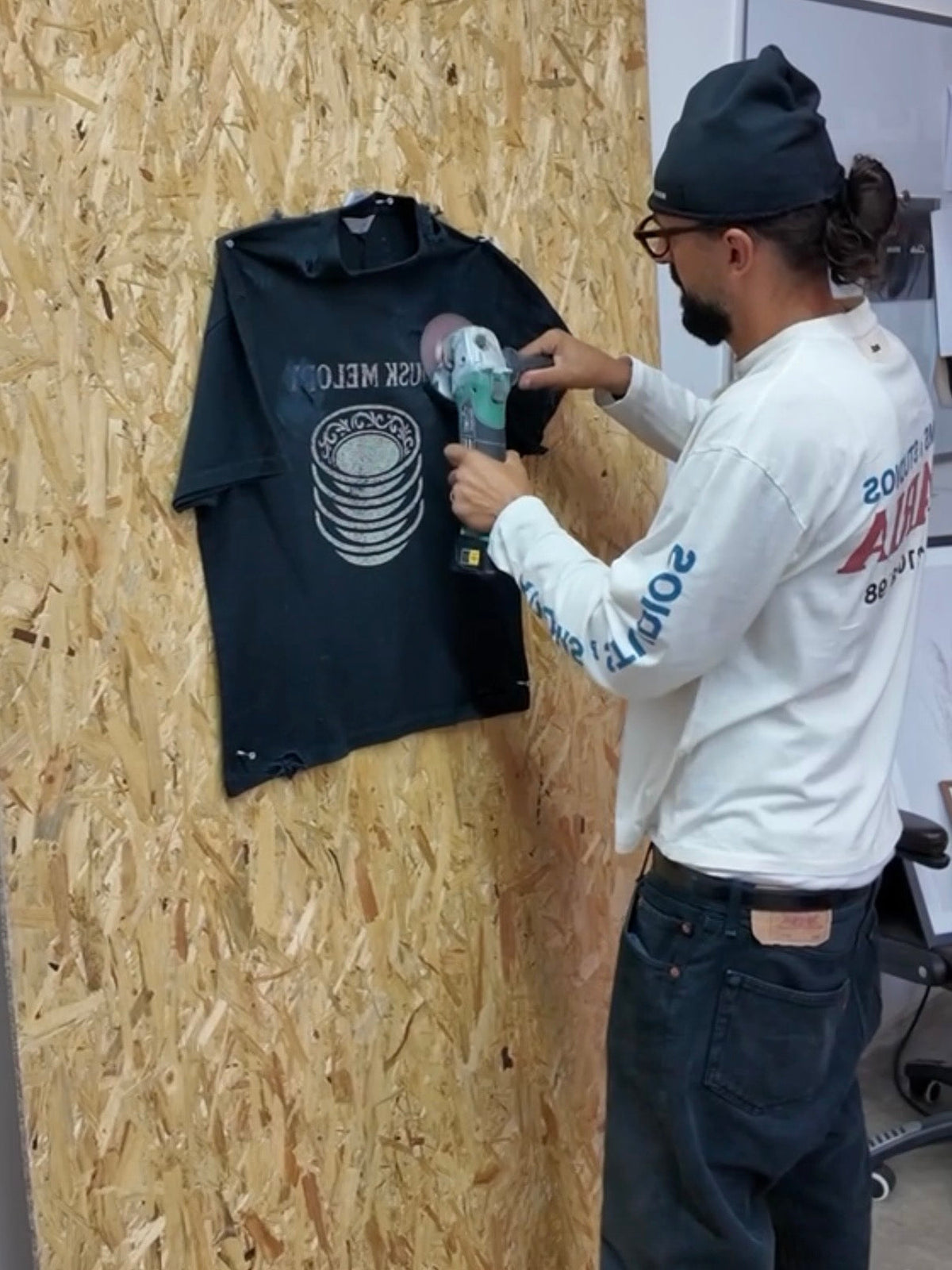
Fabric may be abraded, cut, washed, sanded or worked by hand. Areas that would naturally experience wear can be emphasized, while other parts remain relatively untouched.

The placement matters.
Random destruction can simply make a garment look damaged.
Controlled distressing creates contrast.
A worn collar, an exposed edge or a selectively abraded surface can make a new garment feel as though it already carries history.
Because many distressing techniques are performed or finished manually, small differences between individual garments can occur.
Those variations can become part of the character of the piece.
Reconstruction and Altered Proportions
Deconstruction can also happen without holes or visible damage.
Changing proportion is one of the strongest ways to reinterpret a familiar garment.
A conventional T-shirt can become shorter and wider.
Sleeves can be changed in relation to the body.
A trouser can move from a traditional straight shape toward a much wider silhouette.
Panels can be repositioned or existing construction lines can be exaggerated.
The starting point remains recognizable, but the relationship between its individual elements changes.
This is where deconstruction becomes less about destruction and more about redesign.
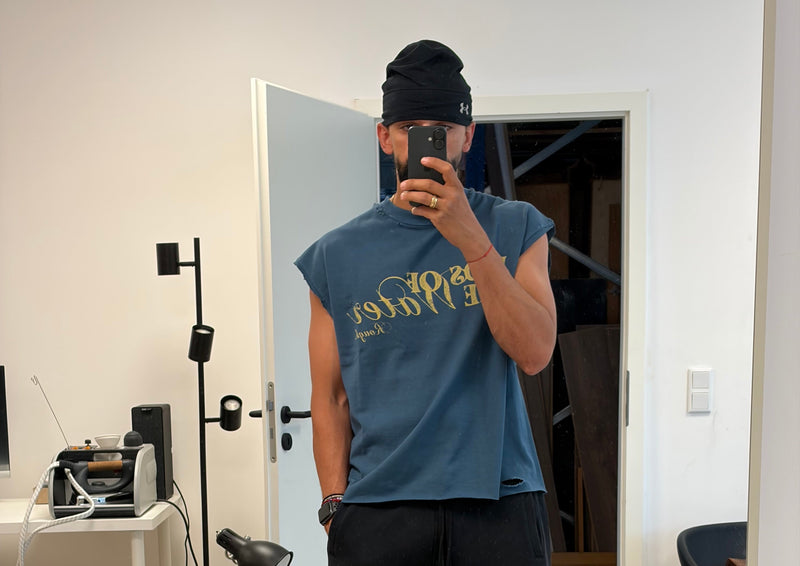
One example of this approach is the transformation of a finished T-shirt into a sleeveless silhouette. Read more about the process in How a T-Shirt Becomes a Tank Top.
Why Imperfection Matters
Most industrial clothing is designed around consistency.
Every piece should ideally look identical.
Deconstructed clothing can deliberately challenge that idea.
A slightly irregular edge, individual abrasion or variation in a distressed surface gives the garment something that perfectly uniform production cannot easily reproduce.
Imperfection can create individuality.
It can also introduce a sense of time.
Clothing normally develops character after being worn for years. Fading, fraying and softened fabric document how a garment has been used.
Deconstruction allows some of those visual traces to become part of the garment from the beginning.
Deconstruction at ROUGH.
At ROUGH., clothing often begins with memory.
That idea also influences how we approach garments.
Rather than treating every piece as something that has to appear completely untouched, certain designs explore wear, altered proportions, exposed edges and physical intervention.
A garment can be cut, distressed or reworked until it carries a different feeling from the piece it started as.
For some designs, that process involves working directly into the finished garment by hand.

The objective is not destruction for its own sake.
It is to find the point where wear, construction and imperfection become part of the identity of the piece.
The process can leave marks.
That is intentional.
Because sometimes a garment becomes more interesting after its perfect surface disappears.
The finished piece is available as the HESPERA T-SHIRT DECONSTRUCTED.
Is Deconstructed Clothing Supposed to Change Over Time?
In many cases, yes.
Raw edges can soften.
Fraying can develop.
Washed fabrics may continue to evolve.
Distressed areas may react differently to wear than untouched areas of the garment.
This means a deconstructed piece can become slightly more individual the longer it is worn.
That evolution should still happen naturally rather than through aggressive treatment.
Following the garment’s care instructions remains important, particularly for heavily distressed pieces.
How to Care for Deconstructed Clothing
Because raw and distressed areas can be more sensitive than conventional finished fabric, deconstructed garments should generally be treated carefully.
Always follow the specific care label of the garment.
When appropriate, washing at lower temperatures, turning the garment inside out and avoiding unnecessary mechanical stress can help preserve distressed details.
Raw edges and intentionally damaged areas should not automatically be treated as defects.
They are part of the construction of the garment.
Deconstruction Is a Process, Not an Effect
The most interesting deconstructed garments are not defined by how damaged they look.
They are defined by what has been changed and why.
Cutting away a hem, altering a proportion, exposing construction or distressing a surface all begin with the same question:
What happens when a familiar garment is no longer treated as finished?
Sometimes the answer is another version of the same object.
Sometimes it becomes something entirely different.
MORE FROM THE JOURNAL
SHOP THE COLLECTION
SHOP NOW